Facebook Twitter Youtube Instagram
Especiales

Más de 600 niñas y niños fueron asesinados en 2023 por el narco en México

Tijuana, Baja California.- En México cada día 2.28 niños, niñas y adolescentes —en promedio— fueron asesinados durante este 2023, de los cuales al menos uno fue por arma de fuego, de acuerdo con estadísticas del Secretariado Ejecutivo del Sistema Nacional de Seguridad Pública

La información cotejada del 1 de enero al 30 de agosto de este año, arrojó que hubo 605 menores de edad asesinados, de los cuales 451 fueron víctimas del disparo de un arma de fuego. También se cometieron 46 feminicidios de menores de 18 años; diez de ellas fueron asesinadas con una pistola. 

El segundo delito más cometido contra un menor de edad fue el homicidio culposo. En este año se registraron —entre enero y agosto— 988 víctimas; la principal causa de muerte es por un accidente de tránsito, un total de 793 niños y adolescentes. Del total de víctimas de este delito, doce personas menores de 18 años murieron por un balazo. 

En comparación con 2022 aumentaron al menos cuatro delitos: la extorsión, en un 4.2%; las lesiones, pasó de registrar entre enero y agosto del año pasado 11 mil 383 víctimas, a este año contabilizar 13 mil 330, un incremento del 17.1%. También, aumentaron los secuestros en un 48.6%; mientras que el tráfico de menores pasó de haber reportado tres el año pasado, a cuatro en este. El número de niños asesinados en 2022 fue 6.8% más que en todo 2021.

Guanajuato fue la entidad que reportó el mayor número de menores de edad asesinados por arma de fuego durante este 2023, con 72 víctimas; seguido de Michoacán, con 33; el Estado de México, con 32Chihuahua, 30Zacatecas, 29; y Guerrero, 24.

La violencia contra este sector de la población, tan solo en agosto, ha dejado 3 mil víctimas de al menos un delito; siendo el mes con más delitos contra la infancia desde 2015. 

La mayoría de los menores de edad asesinados son adolescentes, en condición de pobreza; inmersos en un contexto de violencia, con guerra entre grupos del crimen organizado y fuerzas de seguridad desde hace 16 años, explicó a LINOTIPIA, Juan Martín Pérez García, coordinador de la organización Tejiendo Redes Infancia en América Latina y el Caribe”.

“Hay un contexto estructural y es que nuestro país tiene ya 16 años en guerra. Esto se traduce en más de 16 millones de armas ilegales que circulan en territorio nacional; se ha incrementado la militarización de la seguridad en todos los niveles: municipal, estatal y federal”, declaró sobre el contexto de esta violencia contra niños, niñas y adolescentes. 

El defensor de derechos humanos de las infancias agregó que otro factor que se suma es el de la impunidad que impera en el país, dado que los crímenes en contra de menores de edad no son investigados hasta sus últimas consecuencias, lo que da pie a que los criminales sigan haciéndolo sin una consecuencia. 

“Hace doce años el Comité de Derechos del Niño de la ONU, le recomendó a México cambiar la estrategia de seguridad y de militarización, además de un registro estadístico confiable, para trabajar la cultura de paz y la resolución no violenta de conflictos desde las escuelas. Sin embargo, nada de esto se ha atendido. Cambió la administración a Peña Nieto, cambió la administración a López Obrador y lo único que hicieron fue incrementar la militarización y las muertes”, aseguró el abogado. 

También, dijo que en febrero de 2019 lograron desarrollar una estrategia de seguridad integral, pero nunca la han ejecutado, pese a que en su elaboración estuvo la Secretaría de Gobernación, cuya titular en esa entonces era la ahora senadora Olga Sánchez Cordero, pero que solo se vieron una vez y nunca más volvieron a verla.

El crimen organizado detrás de homicidios de menores de edad

El pasado 18 de septiembre de este 2023, dos niños de seis y once años fueron asesinados en calles del municipio de San Francisco del Rincón, Guanajuato. De acuerdo con el reporte policial, los menores se encontraban con su padre sobre la calle Tamaulipas de la colonia Morelos, a las 19:37 horas, cuando dos hombres a bordo de una una motocicleta dispararon contra la familia en repetidas ocasiones, sin detener su marcha. 

Guanajuato es la entidad más violenta para los menores de edad. En lo que va del año han muerto a causa de un disparo 72. En comparación, en lo que va de 2023 se han registrado 38 niños, niñas y adolescentes palestinos asesinados por las fuerzas israelíes en Cisjordania, convirtiéndolo en el año más mortífero, según Save the Children.

Al respecto el analista en política y seguridad, David Saucedo, explicó que existen tres razones por las cuales en entidades como Guanajuato y Michoacán hay un alto índice de violencia homicida contra menores de 18 años: la primera es el aumento de niños y jóvenes reclutados por el crimen organizado y son asesinados por contrarios o por el gobierno. 

“Debido a una estrategia de reclutamiento de estas organizaciones delictivas donde incorporan a los menores en tareas del narcotráfico como: la venta de drogas, el sicariato y el halconeo, porque es poco probable que sean detenidos y las condenas penales para ellos son menos severas”, señaló el especialista. 

La segunda, las muertes de menores en enfrentamientos catalogados como daños colaterales al ser menores sin relación con los grupos criminales. En tercer lugar, el asesinato de familias enteras en forma de extorsión, como parte de una pugna contra un grupo rival. 

“Las tres variantes que hemos detectado de niños que fallecieron por ataques del crimen organizado, aquellos que fueron reclutados por el narco y que fueron asesinados por esto, los niños que fueron asesinados en estrategia de exterminio de familias y finalmente aquellos que murieron únicamente en las balaceras, en un fuego cruzado en centros comerciales, plazas públicas, centros deportivos, canchas de básquetbol”, detalló David Saucedo

También aseguró que todos los grupos criminales en México reclutan menores de edad, sin embargo, no todos los jóvenes y niños lo hacen bajo su voluntad. El especialista en seguridad agregó que en Michoacán, Jalisco, Tamaulipas y Guanajuato los niños son cooptados de manera forzada por el Cártel Jalisco Nueva Generación, el del Golfo, los Zetas, entre otros; mientras que organizaciones criminales como el Cártel de Sinaloa y el Cartel de Santa Rosa de Lima, tiene una estructura beneficiada de la narco cultura y la tradición familiar. 

Michoacán es el segundo estado con mayor número de niños, niñas y adolescentes asesinados

En lo que va de este 2023 el SESNSP informó que en Michoacán hubo 33 víctimas. Los niños son obligados por los grupos armados a integrarse a sus organizaciones criminales, los que no acceden son asesinados, aseguró el sacerdote católico y ex autodefensa de Apatzingán, Gregorio López Jerónimo. 

En entrevista para LINOTIPIA narró que en la entidad la mercancía más cotizada por la delincuencia son los niños y adolescentes, para el sicariato, actividad altamente solicitada y bien pagada. Los menores desde los ocho años son contratados para trabajos como halcones, los más grande de 12 y 15 años, como matones. 

“Los criminales van a una secundaria, por medio de un grupo de WhatsApp son cooptados por la delincuencia. Se estacionan afuera de la puerta de la secundaria en un taxi y los están esperando, se suben los cuatro cinco chamacos, ahí están las armas, van, hacen el evento, al salir está otro vehículo para que se suban, a cada uno le pagarán 10 mil pesos, y llegan a la escuela cada quien con un buen celular o una iPad”, contó el padre Goyo.

Comentó también que los niños que se niegan a cooperar son asesinados o desaparecidos, otros se ven obligados a huir del estado y migrar a Estados Unidos en busca de asilo humanitario; algunos de estos adolescentes y niños se han quedado huérfanos y viven en condiciones de riesgo en ciudades fronterizas como Tijuana. 

“Los que logran cruzar son canalizados a albergues en Estados Unidos, pero los que se quedan tiene tres finales, el desplazamiento forzado, la indigencia y la cooptación por el crimen organizado, porque el hambre los hace recurrir a hechos delictivos, teniendo como consecuencia la muerte del niño o la niña”, concluyó. 

También te puede interesar: La noche más larga: Las masacres en bares de Torreón

En Michoacán, Guerrero y Jalisco el exterminio de familias completas por parte de grupos criminales ha generado un éxodo a ciudades fronterizas para buscar asilo humanitario en Estados Unidos y poner a salvo a sus hijas e hijos de la violencia.

A la familia Martínez la dejaron sin un solo varón, luego de que una tarde un comando armado llegara a su domicilio y asesinara a todos los hombres de la casa, las mujeres tuvieron que huir a Tijuana, la razón: no quisieron trabajar para un grupo criminal identificado como Los Ardillos. 

“Mi esposo les dijo ‘pero ¿por qué me voy a salir?, si es mi casa, o sea, qué quieren’, y empezaron a dispararles bien feo y cayeron cerca de nosotros. No pudimos hacer nada, nada, nada, con esa gente. Ya cuando oímos que dejaron de disparar, nos paramos y mis niñas, todas, arrinconadas en el baño”, contó la madre y esposa de las víctimas a LINOTIPIA.

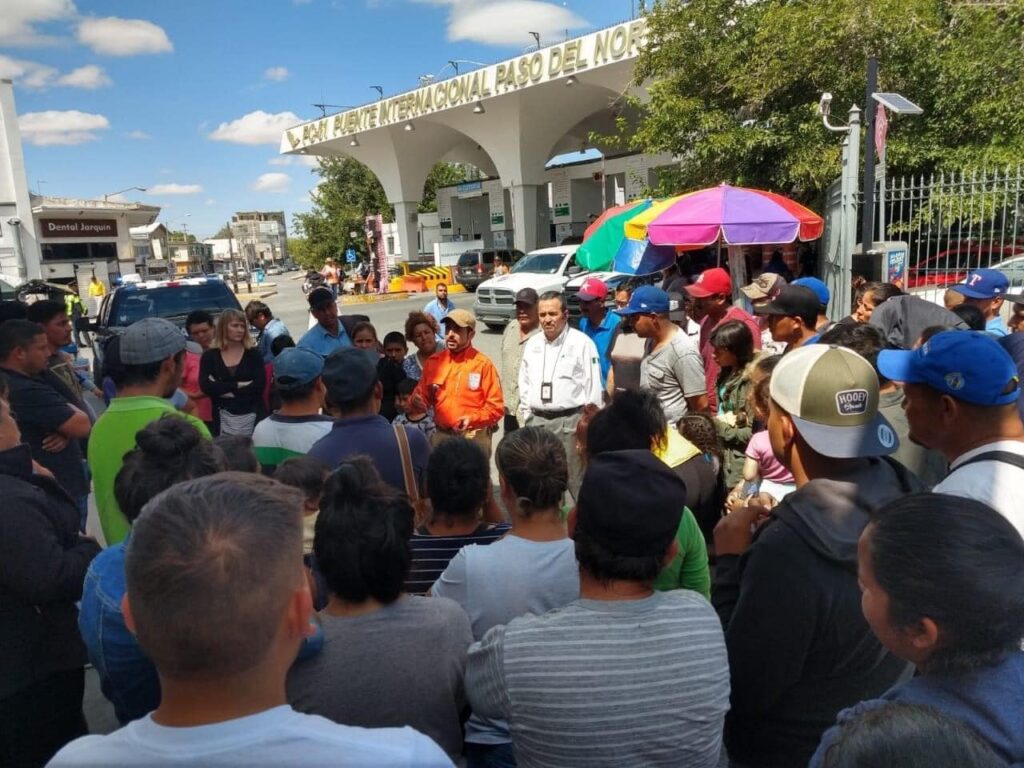
Migrantes.- mexicanos desplazados a la fuerza, por el crimen organizado arriban a Tijuana para solicitar refugio en Estados Unidos / Foto Alejandro Arturo Villa.

De acuerdo con una investigación publicada por el Complexity Science Hub en la revista Science, el crimen organizado es el quinto empleador en México con casi 175 mil personas en su nómina, por encima de empresas como Pemex y Oxxo; superado por Walmart, América Móvil, FEMSA y Manpower.

También revelaron que dos de cada 10 personas pertenecen al CJNG y uno de cada 10 al Cártel de Sinaloa. Del total de reclutados el 17% fueron asesinados. En su mayoría obligados y amenazados para trabajar con ellos. 


PUBLICACIÓN ORIGINAL DE LINOTIPIA QUE PUEDES LEER AQUÍ

Border

Route to CU: few units and setbacks


Translated by Jesús Ronquillo / Circuito Frontera


The lack of public transportation units for many students who use this means to get to the Ciudad Universitaria campus of the Universidad Autónoma de Ciudad Juárez (UACJ), can sometimes result in waiting up to 30 minutes in a subdivision in the southeast of the city.

Click here for the Spanish version

This is due to the fact that it is common for drivers to refuse to go to the UACJ institute if only a few students are on board, leaving the passengers in the last subdivision.

This means that students must wait between 20 and 30 minutes for another bus to arrive and take them to the university campus, which consequently makes them late for their classes, said Melanie González, a 22-year-old eighth-semester psychology student.

The situation is a challenge for hundreds of university students, because although the UACJ received more than eight thousand new students this academic year, at least 1,800 must go to the campus located in the southeast of the city, better known as Ciudad Universitaria.

In order to get to this space, located outside the urban area, most of them use public transportation as an essential part of their daily life as students. However, only two bus lines reach the institute: the Universitaria and the Express.

Location Ciudad Universitaria UACJ / Photo: Google Maps

According to the Socioeconomic Radiography 2022-2023 of Ciudad Juárez, conducted by the Municipal Institute of Research and Planning (IMIP), according to data from the Population and Housing Census of INEGI 2020, at least 13.9 percent of the population uses public transportation to go to educational centers.

Also, 45.6 percent take between 15 and 30 minutes to get to their destination, and 30 percent take up to an hour to get to their destination.

Not to mention that at the beginning of April there was an increase of 4 pesos for the border routes, going from 8 to 12 pesos and 2 pesos for the ViveBús or BRT units, whose cost changes from 8 to 10 pesos.

The above, after an increase was approved by the Consultative Council of Ciudad Juarez, through a consensus in the facilities of the offices of the State Government, on the increase in the cost of public transportation fares, which was applied the same rate for the 67 municipalities of the entity.

Melanie said that for four years she has used a bus from the «Universitaria» line to access CU, as well as to take a waiting unit on Talamás Camandari Avenue.

So her experience can be a journey full of ups and downs, ranging from the struggle to get to her classes on time to the pleasant surprise of improved bus facilities.

«I regularly get on the bus and say ‘good afternoon’ and they answer me the same way, but before I used to see rude drivers, although now I don’t notice it so much, as they are very calm», she said.

A unit of the University Line arriving at the CU campus / Photo: Aimé Salinas

When talking about improvements, Melanie also highlighted that public transportation facilities have undergone notable improvements, such as now having more seats and signs have been installed that emphasize important rules, such as «no smoking» or «no alcoholic beverages on board».

Another student who shares her experience on public transportation to CU is Jackeline Delgado, also 22 years old and a ninth semester law student.

Like Melanie, this young woman has been taking the Universitaria route to take classes for four years, waiting on Avenida de Las Torres and facing a 45-minute ride to get to the university.

Jackeline shared that fortunately she has never faced unpleasant situations, other than standing still for a long ride.

Although she pointed out that her main concern lies in the discomfort of traveling in overloaded buses, as drivers very often continue to allow passengers to board, even when the vehicle is full.

 Passenger truck heading to Ciudad Universitaria / Photo: Aimé Salinas

«Fortunately, I have never had to suffer harassment on a bus, nor any other unpleasant experience such as an assault, I have always done well on the trucks (…) Suddenly they drive something ugly or go very rough (the drivers), but nothing exaggerated. Nothing out of order. I could say that my experience in the trucks has been good», he said.

On the other hand, José Acosta, one of the public transportation drivers that goes to the UACJ institute, explained that, particularly in his case, getting to Ciudad Unidad is a necessity.

The driver indicated that this location is crucial, since the station is nearby, as it is there where he has to load diesel as fuel for the bus.

Although he said that for many drivers it is not profitable to get to the university campus, due to the costs associated with this route.

«There are times when one or two students go and sometimes it is not convenient to take them there… it is not convenient to go back, since it is too expensive to go up», he mentioned. 

Frontera

Migrant women: bodies without rights


Translated by Jesús Ronquillo / Circuito Frontera


Migrant women face a deadly journey in Mexico in their attempt to reach the United States with the threat of sexual abuse, forced pregnancy, fetal death and a high risk of death if they are pregnant. Testimonies collected in the field make it clear that, for them, migrating is almost a sentence. 

In comparison with Mexican women living in the country, foreign women who are pregnant in Mexico are almost 20 times more likely not to achieve a pregnancy, according to their own calculations based on data from the National Institute of Statistics and Geography (INEGI), and face a high risk of maternal death.

For this research, migrant women were interviewed at different points along the migratory route that crosses Mexico from south to north. From the Suchiate River and Tapachula, in Chiapas, through Las Choapas and Coatzacoalcos, in Veracruz, to the two extremes of the northern border, in Tijuana and Reynosa, where they talk about how they face the lack of contraceptive methods, abortifacients and health services.

**This report was produced with the support of the International Women’s Media Foundation (IWMF) as part of its Reproductive Rights, Health and Justice in the Americas initiative**

Gelsy, a 19-year-old Honduran woman, sleeps on a shared mattress in a shelter in Tapachula, Chiapas, under a laminated roof from which streams of water escape. She is a mother but no longer wants to give birth. Her country prevented her from having surgery because she was under 21.

Click here for the Spanish versión

That is why, before starting her journey to the United States, she wants to buy an emergency pill to have an abortion if she is sexually assaulted, because migrating and suffering abuse, she says, is almost a certainty in Mexico.

-There are many things you hear… the girls on the road say that it is very risky, most of the women who have been raped tell of the experience.

Inside the Buen Pastor shelter in Tapachula, where Gelsy lives, the women watch the time pass, lying on the floor in front of a useless fan. They fan themselves with newspapers that only blow hot air, place wet rags around their necks and, as they do so, organize themselves to look for contraceptives or emergency pills before continuing on their way.

A woman hugs her son in a makeshift migrant camp in the city of Tapachula, in the state of Chiapas. Photo: Alicia Fernández.

The condoms given to them by organizations and volunteers, the migrants say, are of no use to them in case they are raped or if their partner refuses to use them.

In the same shelter, another migrant, who preferred not to give her name, recalls that in Guatemala, before crossing the Suchiate River, which marks the border with Mexico, she was offered prostitution to pay for a hotel room. She had saved to leave Honduras, but the money ran out when she paid the pollero and he abandoned her.

-They told us that’s the only way they can get there, by prostituting themselves… because you need money,» she says with conviction.

For migrant women without a regulated stay in Mexico, having access to contraceptives is indispensable in their luggage because they know they are likely to be sexually abused or use their bodies in exchange for a man for a sense of security.

But access to sexual and reproductive health services is a right that is not guaranteed for the thousands of women who cross the country in vulnerable conditions due to their migratory status, according to the testimonies of migrants and organizations along the route from the southern border to the north of the country.

In its 2021 report, the Institute for Women in Migration (Imumi) reveals that seven out of every 10 women they attended experienced physical violence during their transit through Mexico; 83 percent psychological violence, 60 percent patrimonial violence, 42.5 percent economic violence and 18 percent sexual violence.

Pregnancies at risk

Not only are women who want to prevent pregnancies at risk, but also the lives of those who are already pregnant and are crossing the country in extreme weather conditions, with dehydration and without food.

One of the epicenters of the migratory route is the train station in Coatzacoalcos, Veracruz, where hundreds of migrants wait for the train to stop in order to board and head north. There, among the garbage, rats devour leftover food thrown a few steps away from where hundreds of people sleep on top of cardboard boxes on the ground, in temperatures of almost 40 degrees Celsius.

Among them is Jaime, a Honduran woman five months pregnant who, after leaving her country, has not seen a doctor.

She stopped at the train station where she met other migrants. Hardly anyone knows she is pregnant because her body is so thin that it barely allows a small bulge of her belly to peek out. She says she eats once a day, takes no vitamins and her body has been exposed to physical wear and tear. She thinks she and her child will survive because of God.

Jamie, a pregnant Honduran migrant, travels by truck from the train station where she has slept for the past few days to a shelter in Coatzacoalcos, Veracruz. Photo: Alicia Fernández.

– I pray to God that everything is all right,» she says as she entrusts herself to her faith, and then explains that her baby has not moved, nor does she know if it is a girl or a boy, nor why her belly is so small, she has never had an ultrasound and, since she set foot in Mexico, she has not had a medical check-up.

The chances of her baby not being born are much higher for her than for a woman born in Mexico.

Compared to Mexican women living in the country, foreign women carrying a child in Mexico are 17.1 times more likely to fail to achieve a pregnancy, according to their own calculations based on data from the National Institute of Statistics and Geography (INEGI).

This figure was arrived at by comparing the proportion of fetal deaths in Mexican mothers, which was 1.98 percent in 2022, with that of fetal deaths in foreign women, which reached 34 percent that same year.Through the National Transparency System, information was requested from health institutions in the country’s 32 states on maternal deaths, perinatal deaths, prenatal care and births of foreign women registered from 2020 to July 2023, but only 12 responded with data.

Of these, seven states reported perinatal deaths (when it occurs after 22 weeks of gestation up to seven days after birth): Chihuahua, Coahuila, Jalisco, Tlaxcala, Nayarit, Veracruz and San Luis Potosí. In the latter state, one perinatal death was recorded, as well as 13 abortions to foreign women.

The information indicates that of the 51 perinatal deaths in foreign women registered from 2020 to July 2023, half occurred in Coahuila and Chihuahua. In addition, an upward trend is observed, since during the first seven months of 2023, nine fetal deaths were registered, very close to the 10 registered in all of 2022.

In relation to maternal deaths, Baja California registered half of the country’s cases reported through transparency, with five deaths between 2020 and 2023.

Of these, seven states reported perinatal deaths (when it occurs after 22 weeks of gestation up to seven days after birth): Chihuahua, Coahuila, Jalisco, Tlaxcala, Nayarit, Veracruz and San Luis Potosí. In the latter state, one perinatal death was recorded, as well as 13 abortions to foreign women.

The information indicates that of the 51 perinatal deaths in foreign women registered from 2020 to July 2023, half occurred in Coahuila and Chihuahua. In addition, an upward trend is observed, since during the first seven months of 2023, nine fetal deaths were registered, very close to the 10 registered in all of 2022.

In relation to maternal deaths, Baja California registered half of the country’s cases reported through transparency, with five deaths between 2020 and 2023

Pregnant migrant traveling with two daughters and her husband sheltering from the rain in the plaza of Ciudad Hidalgo on one side of the Suchiate River. Photo: Alicia Fernández

The presence of migrant women in Mexico has also multiplied in recent years. One indicator is the delivery of cards for humanitarian reasons granted by the Mexican government, which grew four times since 2020, when 10,763 documents were delivered and increased to 53,277 in 2022.

From January to July 2023 alone, 31,465 gestational pregnancy consultations were offered to foreigners in the country -regardless of their migratory status-, 76 percent of which were concentrated in just 10 states.

****

Mexico, a wall to migrant women’s health

Valeria Scalisse, head of the Psychosocial Accompaniment area of the civil organization Institute for Women in Migration (Imumi), warns that the lack of reproductive rights has to do with the government’s lack of will, but mainly with migration policies that are now more restrictive and force women to use routes with more risks and fewer services.

«It directly or indirectly influences women’s access to (health) services, I remember Venezuelan women commenting that they would rather go through the Darien (the jungle on the border between Colombia and Panama) twice than go through the Mexican routes; I thought it was very strong to hear that,» she says.

Crystal P. Lira, co-founder of the pro-abortion collective Las Bloodys, in Tijuana, explains that when it comes to residents of the region, they provide an average of 150 to 300 accompaniments per month, but in the case of migrants they only provide between one and five.

Doulas from the organization Partería y Medicinas Ancestrales, located in Tijuana, accompany a pregnant migrant woman and her daughter. Photo: Alicia Fernández

«Migrant women are more vulnerable and have less access to means to prevent or avoid an unwanted pregnancy due to the centralization of access and information, language, documentation, the various criminalizations due to their condition, as well as economic and housing inequality, it is not easy to migrate», explains the activist.

Araceli Pineda, assistant director of Programs at ProSalud, a civil organization that promotes health and works with women in the context of mobility, maintains that migrants are at greater risk of not achieving a pregnancy.

«Sometimes they don’t know they are pregnant and when they have very strong pains, it is due to miscarriages, poor nutrition… due to their lack of access to bathrooms and hygiene», said.

The specialist warns that the Mexican health system does not guarantee access to prenatal care or for the termination of pregnancy. The main barriers, she says, are the cultural beliefs of both migrants and those in charge of the institutions and organizations that surround them, such as the shelters where they arrive, which are mostly coordinated by religious communities.

Prepared to migrate

Devora, a salvadoran migrant who was sexually assaulted in her country, became pregnant and tried to terminate the pregnancy with emergency pills, but the medication did not work. Nearly six months pregnant, in April 2023 she decided to migrate alone to the United States.

She arrived at the eastern border of Mexico and the United States, in the city of Reynosa, where when the sun rises it burns the skin. As soon as night falls, businesses lower their curtains and families hide inside their homes, as if sequestered within their own four walls, and from there, they learn to live amidst the sound of bullets that ring out almost daily.

After suffering sexual abuse, Devora traveled from El Salvador to the city of Reynosa, Tamaulipas, to cross into the United States. Photo: Gabriela Martínez

Devora took refuge in Casa Lulu, one of the few shelters in the city that receives migrant victims of torture and sexual abuse, where she told her story and despite her desire not to be a mother, she was assured that children are a blessing and that those who are not yet born are not to blame for her aggression.

Resigned to a forced pregnancy, she thinks that the only thing she was afraid of was being murdered or disappearing along the way, because she was not afraid of another abuse.

-I did know that it could happen (rape) but it is a risk one takes… I didn’t feel fear as a woman that I might lose something.

Mexico’s Migration Law obliges the State to guarantee health services regardless of migratory status and there are international agreements that demand respect for the reproductive rights and sexual health of migrant women -including abortion-. But in this country, quality medical care is the exception rather than the norm.

Before starting their journey, many migrant women inject themselves with contraceptives that last for three months to avoid unwanted pregnancies, but when they are detained at the border, the effect wears off before they start their journey. From the shelters and during their transit they look for where to buy the injection, but the cost and lack of access make it inaccessible.

Escarleth, a 22-year-old Honduran woman, has been unsuccessful in purchasing her injection. Suspecting an unplanned pregnancy, she searches among organizations and volunteers for someone to help her with contraceptives for women. Her partner refuses to use a condom.

People who have come, volunteers, have left condoms and you take them… but there are people who use them to play with. What do I do with them?

Report replicated with authorization from Conexión Migrante


TEAM

Project Manager

Patricia Mercado Sánchez

Editing:

Nadia Sanders

Research:

Gabriela Martínez

Photos and Videos:

Alicia Fernández

Digital Design:

Jhasua Razo

Administration:

Sofía Montellano

Frontera

Preparatoria 8401 en crisis: sin luz y aulas en riesgo de colapso

La falta de luz y los daños causados por la lluvia del pasado 26 de septiembre en Ciudad Juárez han llevado a una situación de crisis a la Preparatoria Estatal 8401 que, incluso, pone en peligro a los alumnos y al personal docente.

«El 26 de septiembre que tuvimos una lluvia colapsaron tres de los salones. Viene Protección Civil y hace un reporte donde nos clausura tres de los salones. Sin embargo, nos dice que el daño la infraestructura de la institución no está en condiciones como para soportar otra lluvia», declaró el profesor Saúl de la Rosa García.

Indicó que esa fuerte lluvia que causó el colapso de tres salones, obligó a personal de Protección Civil a intervenir y clausurar las aulas, alertando sobre la debilitada infraestructura de la institución.

Una de las aulas clausuradas tras colapsar el pasado septiembre / Foto: Redacción CF

Sin embargo, los docentes continuaron dando clases a los 430 alumnos con que cuenta la institución, con luz a medias y con la falta de tres salones, refirió la profesora Marcela Acosta.

Aunque esta situación no pudo sostenerse más tiempo, pues tras la falta de apoyo de las autoridades estatales, las clases fueron suspendidas el pasado lunes 16 de octubre.

La docente expuso además que la problemática pesiste desde el pasado mes de abril, ya que la prepratoria cuenta con el servicio de luz en solo la mitad de la institución.

Y, pese a las denuncias ante las autoridades de la Subsecretaría de Educación de Gobierno Del Estado, su reclamo no fue escuchado, por lo que el colapso de las aulas solo emperó la situación, disminuyendo aún más la capacidad de la escuela para impartir clases de manera efectiva.

Dijo que la mayoría de los salones se encuentran en condiciones precarias, afectando el proceso educativo de cientos de estudiantes, pues a pesar de que Gobierno del Estado les aseguró que ya está autorizado el pago del servicio de luz de la escuela, no han instalado el medidor correspondiente.

@circuitofrontera La falta de luz y los daños causados por la lluvia del pasado 26 de septiembre en #ciudadjuarez han llevado a una situación de crisis que, incluso, pone en peligro a los alumnos como al personal docente de la Preparatoria Estatal 8401. Sin embargo, los docentes continuaron dando clases en la escuela, con luz a medias y con la falta de tres salones, a los 430 alumnos con que cuenta la institución. Aunque desde el pasado lunes, las clases se están suspendidas. #alumnos #escuela #preparatoria #clases #daños #escuelamediasuperior #viral #trending #new #maestrosdeméxico #fyp #educacion #Chihuahua ♬ original sound – Circuito Frontera

Señaló que el conflicto con la Comisión Federal de Electricidad (CFE) ha dejado a la escuela en la penumbra, ya que solo dos medidores no son suficientes para abastecerla por completo.

Por lo que, con la mitad de los grupos trabajando en condiciones precarias, los docentes se vieron obligados a realizar una suspensión de labores.

Aunque el paro laboral es un grito de auxilio en busca de soluciones concretas que permitan a esta institución seguir brindando educación de calidad.

Docentes se han manifestado tras la falta de apoyo de las autoridades estatales / Foto: Redacción CF

Recalcó que esta incertidumbre no solo afecta a los docentes, sino también a los jóvenes estudiantes, pues la matrícula es constantemente supervisada por las autoridades estatales, y cualquier disminución puede resultar en una reducción de recursos.

Estos daños en la infraestructura y la falta de servicios no solo afectan la continuidad de la educación en la Preparatoria 8401, sino también de los alumnos de la Escuela Secundaria Jesús Urueta 8347, la cual imparte clases en el mismo espacio, pero en el turno matutino.

La Preparatoria 8401 forma parte del sistema educativo estatal, pero han transcurrido seis meses sin que reciban una respuesta que resuelva las problemáticas que enfrentan, concordaron los docentes entrevistados.

El techo de tres aulas colapsó tras las lluvias, aunque el servicio de luz estaba limitado desde abril / Foto: Redacción CF

De tal manera que los profesores exigen una inspección detallada de la escuela por parte de un perito y la restauración de la infraestructura dañada, así como se les reubique en un edificio adecuado.

Los profesores y alumnos de la Preparatoria 8401 esperan que esta situación sea abordada de manera urgente por las autoridades, con el fin de garantizar un entorno educativo seguro y adecuado.

Border

U.S. authorities warn that laws remain unchanged


Translated by Jesús Ronquillo / Circuito Frontera


U.S. authorities warned that there is no change in immigration laws or border control, so it is false that migrants will be allowed to enter the country.

Click here for the Spanish versión

«Rumors that a U.S. government shutdown will allow migrants to enter the country are FALSE. Migrants should continue to schedule CBPOne appointments,» reported Border Patrol (CBP) personnel.

U.S. immigration officials and CBP officers and agents will continue to enforce the laws.

In this regard, Gloria Chavez, Border Patrol Chief for the Rio Grande Valley Sector, issued a message emphasizing the importance of the Border Patrol’s work, regardless of governmental circumstances.

«It’s super important to me and our workforce that everyone knows we are working in the field, we are going to keep working every day, closed governments or not. Our mission is ongoing, doing our job so we can keep our homeland safe and secure,» he said.

 More than 80 percent of CBP’s workforce, which includes all Border Patrol agents and field operations office officers, will continue to work without pay.

We will be there with our U.S. Coast Guard partners who support maritime migration control efforts across the maritime borders.

The Border Patrol chief stressed that the agency provides security at more than 7,500 miles of border and all 300 ports of entry combined.

Comunidad de medios